IoT is used in a smart waste management system to ensure efficient door-to-door waste collection.
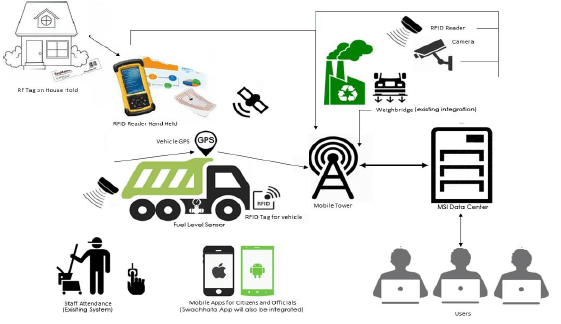
Internet of Things (IoT) is a technology used in an intelligent waste collection system for micro-level monitoring of door-to-door waste collection. NEC India uses RFID tags to detect whether a trash bin is full.
The sensors on the trash bins help in keeping track of uncollected bins. A real-time alert is generated with the help of RFID tags, which ensures that the waste collector doesn’t miss any full trash bin.
The weighbridge monitoring system in smart waste collection uses three cameras. The first camera focuses on the license plate of the truck, the second camera focuses on the trash bin, and the third camera focuses on capturing the waste.
The operations can be optimized with the help of IoT. Real-time information is generated about the waste bins that have to be collected. The waste-collecting vehicle can optimize its routes based on the information available about the trash bins that need to be collected.
The waste management contractor can prepare an analytical report based on the data combination of vehicle movement and reading of RFID tags.
A real-time status of the incidents across the city can be gathered with the help of IoT technology. Sensor-based PTZ cameras provide live feeds to the municipality about incidents like unauthorized waste dumping.
A citizen can also register his or her grievances with the help of a city-level application. A contact center can facilitate the citizen in registering their grievances.
The waste collection contractor can track the vehicles with the help of IoT. This will ensure that the waste collection is efficient. In addition to this, the waste collector can do route replays to check for any discrepancies.
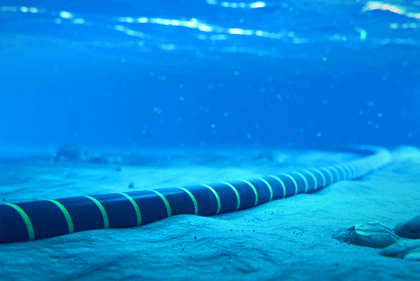
CANI submarine optical fiber cable project has empowered the dreams of students in the Andaman & Nicobar Islands. Better connectivity has helped local businesses grow.
Technology has helped many achieve the aspirations that students have dreamt of. NEC India’s Chennai-Andaman & Nicobar Islands (CANI) submarine optical fiber cable project has proved to be a visionary project as it is helping many cutting across socio-economic backgrounds achieve their goals.
The ambitious endeavor empowers the dreams of many people living on the remote archipelago. With better intra-island connectivity, the residents can be assured of better services related to health. But, the biggest beneficiary of the sub-sea optical fiber network is those seeking a better education facility.
There were many challenges faced by students before the CANI project was launched. “Students used to face problems in reaching out for books and for classes. Everything was impossible. Children can access other universities in Chennai and Kolkata, and across the world,” says Ms. Pearl Devdas, Principal-In-Charge of JNRM College in Port Blair.
Children had to go to the mainland in order to cater to their needs for coaching. With the coming of Optical Fiber, they can be stationed at Port Blair and adjoining areas and get benefits from the mainland.
In the absence of any optical fiber, the bandwidth was limited to 1 Gbps only. Because of this, they faced issues with connectivity and accessing internet-based services. But, since the launch of the CANI project, students have witnessed a transformation.
In addition to the students, hoteliers, and tourists have also reaped the benefits of the optical fiber network. Most of the tourists had difficulty making calls from the comfort of their rooms. But, after the launch of the sub-sea optical fiber network, their calls connect easily from anywhere.
The use of different payment gateways has also become far easier after the advent of the sub-sea fiber cable network. Local shopkeepers say that buyers can use online payment solutions for purchases. Their business has been growing since the launch of the sub-sea optical fiber network.
Technologies can help in ensuring a seamless and safe journey for flyers. Biometric solutions developed by ICT companies. They provide technologies that can ensure that the passengers are authenticated without any hassle. They also help in ensuring a safe journey for the passengers.
A number of technologies have been developed by NECI to help airlines and airport increase the efficiency of the processes that the passengers have to go through before they board the flight. NECI’s advanced face recognition technology that uses AI is helping them reduce the friction at the airport. It can help the passengers in the processes right from check-in, and baggage drop till the time they board the flight.
Solutions of NEC are helping airports and airlines
NEC uses AI-based facial recognition technology to reliably authenticate a person during processes till the time a person boards the flight. Let us take a look at the solutions developed by NEC for ensuring frictionless travel for passengers.
Effortless check-in and bag drop
Baggage drop-off and check-in get frictionless with the use of NEC’s solutions. Passengers who have opted to use their Digital IDs can quickly check-in and drop off baggage without the need to show a passport and boarding pass. They can register them using an App on their smartphone. Since airports and airlines can manage with fewer staff, these solutions will cut the cost of staffing more people.
Airport display solutions
Flight disruptions can result in a change of boarding gates. Real-time updates need to be provided to the passengers about any changes. A full suite of customizable and intelligent display solutions is provided by NEC Corporation India. They can create a better user experience for an air passenger. These displays can provide passengers with useful information about their destination.
Payments for shopping at airports
NEC’s digital ID management platform will eliminate the need for a traveler to show a boarding pass when they do shopping at an airport retail shop. This makes the entire process frictionless and also reduces the time consumed. The passengers can utilize the transit time to buy the items of their interest in a short time.
Personalized lounge experience
Manual identity checks will not be required at the airport lounge if the passenger is authenticated biometrically. Valued customers of airlines can be provided with a personalized lounge experience using NECI’s VIP customer biometric authentication solution.
Border Control
NEC India’s automated border control solution will eliminate the requirement to manually authenticate the traveller using documents. Queues at immigration counters can be avoided by ensuring social distancing.
Maintaining a list of the flight crew and passengers
Maintaining the details of each and every passenger and crew member of a flight is required. Pre-screening of the passengers can be done by the immigration authorities using this information. Flight Manifest solution of NECI helps an airline manage the passenger information using biometrics. This makes the flight manifest solution much more reliable.
Managing the congestion at the airport
Congestion can be a big problem for airport operators. The congestion management solution of NECI uses cameras installed at different locations in the airport to provide real-time information about crowd flows. Visualizing crowd density will be possible when this technology is used. Image analytics is used to determine the direction of crowd movement and the number of people in a crowd. The system does not require the transmission of the images as it uses edge computing. The data processing is done on the device where the data is created.
Keep track of the passengers
NECI’s passenger flow management solution can help an airline instantly identify and locate any “no-show” passenger, sick passengers and lost kids in real time. It uses security cameras with sensors to identify the passengers of interest. These cameras, located at different locations, provide real-time feeds for locating passengers. The feeds can be accessed using a smartphone. Airports and airlines need to make the processes frictionless to ensure a safe journey. To know more about how NEC’s solutions, many of which use face recognition technology, can help them make the processes frictionless, click on the link given below. https://bit.ly/3JDQUVk

 NEC Corporation India